
When we want to show that something belongs to someone or something we use the possessive in English.
Possessive Nouns
We usually do this by simply adding an apostrophe + s ('s) to a singular noun and an apostrophe (') to a plural noun ending in s. For other plural nouns, we also use apostrophe + s ('s). For example:
Singular nouns:
There is a party tomorrow at David's house.
Plural nouns ending in s:
This is my grandparents' favourite place.
Other plural nouns:
The children's shoes are so dirty.
Some other common examples of irregular plural nouns are:
- Women
- Men
- Mice
- People
So that we don't repeat ourselves, we can use the possessive instead of a noun phrase:
Is that John's bike? No, it's Kate's.
Whose coat is that? It's Tanya's.
The structure of forming a possessive can be used for whole phrases. Such as:
The owner of the shop's cousin (the cousin of the owner of the shop)
The Queen of England's corgis (the corgis of the Queen of England)
In some other languages it is common to use of to show possession but in English, it is a lot more common to use the possessive. The following phrases mean exactly the same but the second one is a lot more natural sounding.
- The sister of my best friend.
- My best friend's sister.
Possessive Proper Nouns
We use the possessive with proper nouns (names) very often in English.
- This is Kevin's dog.
- Mark's car is very nice.
- I love Danielle's bag.
When a name ends in s, we usually treat it just like any other singular noun.
- This is Jess's seat.
In some cases, with older, classical names or very important figures, it is also possible to just add the apostrophe (')
- Mary was Jesus' mother.
Possessive Adjectives
We use possessive adjectives in English in three main ways.
- To show something belongs to somebody:
- That's my car
- For friends and relatives
- This is our mum.
- For parts of the body.
- I just need to brush my teeth, then I'm ready to go.
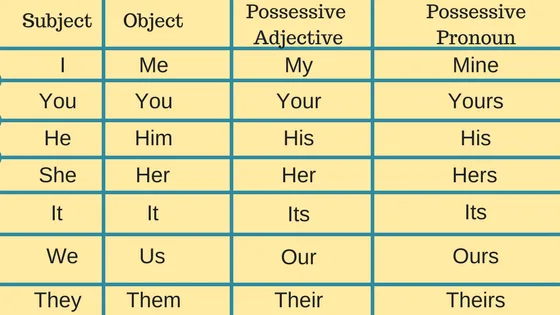
Possessive Pronouns
In addition to possessive adjectives, we also have possessive pronouns. We can use a possessive pronoun instead of a noun phrase. Remember these examples from earlier?
Is that John's bike? No, it's Kate's.
Whose coat is that? It's Tanya's.
If we didn't know the names of the people, we could change the sentences as follows:
Is that John's bike? No, it's hers.
Whose coat is that? It's hers.
We can use possessive pronouns after of:
We could say:
Jim is one of my classmates.
Jim is a classmate of mine.
But we couldn't say
Jim is a classmate of me.
Possessive Questions
We use whose to ask who something belongs to. We can do this in two ways:
We can say:
- Whose coat is this? Whose car is that? Whose bags are those?
- Whose is this coat? Whose is that car? Whose are those bags?
Possessive Reciprocal Pronouns
Reciprocal pronouns are used when two or more people do the same thing. For this, we use each other and one another.
For example:
Julie and Harry copied each other in the English test. Julie and Harry copied one another in the English test
In its possessive form, we use each other's or one another's. For example:
Julie and Harry copied each other's answers in the English test. Julie and Harry copied one another's answers in the English test.
So there we have it, this is our comprehensive guide to possessives in English, covering, nouns, adjectives, pronouns, questions and reciprocal pronouns. If you have any questions, please don't hesitate to ask us. If you would like to learn more why not check out this post: English Grammar - this, these, that, those.